


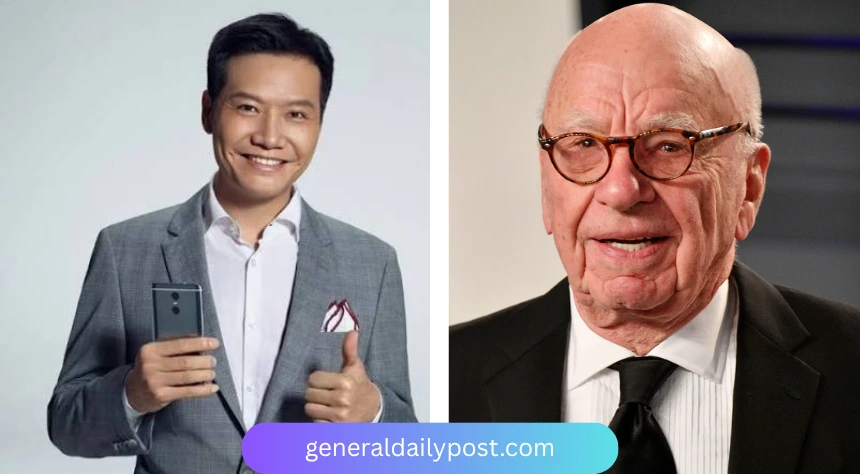
Rupert Murdoch and Lei Jun built their reputations in different industries, but both became closely identified with companies that reached millions of people. Murdoch expanded an Australian newspaper inheritance into an international media business. Lei moved from software development into smartphones, connected devices, and electric vehicles. Their stories span different generations, economies, and forms of influence. One helps explain how newspapers and television became global businesses; the other shows how software expertise can support a consumer technology brand. This biography comparison follows their early lives, major decisions, achievements, and challenges, while distinguishing their historical accomplishments from the roles they hold today.
Rupert Murdoch and Lei Jun at a Glance
| Detail | Rupert Murdoch | Lei Jun |
|---|---|---|
| Known for | International media expansion | Co-founding and leading Xiaomi |
| Birth | 11 March 1931, Melbourne, Australia | December 1969, China |
| Age on 7 November 2026 | 95 | 56 |
| Higher education | Worcester College, Oxford; philosophy, politics, and economics | Wuhan University; computer science degree, 1991 |
| Main companies | News Corp and Fox Corporation | Xiaomi and Kingsoft |
| Current position | Chairman emeritus, News Corp and Fox | Founder, chairman, and CEO, Xiaomi |
Rupert Murdoch’s Early Life and Family Background
Keith Rupert Murdoch grew up in a family already connected to journalism. His father, Sir Keith Murdoch, worked as a journalist and newspaper executive, while his mother, Dame Elisabeth Murdoch, became known for philanthropy. He later studied at Worcester College, Oxford. His father’s death in 1952 changed the direction of his life: he inherited interests in Adelaide’s newspaper, The News. That inheritance gave him an entry into publishing, although the international expansion came later. His family has also remained part of his public story. He has six children and married retired biologist Elena Zhukova in 2024, marking his fifth marriage.
Building a Global Newspaper Empire
Murdoch became publisher of The News in 1953 and took control of News Limited in 1954. Expansion followed through acquisitions and new publications. He launched The Australian in 1964, then acquired Britain’s News of the World and The Sun in 1969. His interests later included the New York Post, The Times, and The Sunday Times. In 2007, News Corporation acquired Dow Jones, publisher of The Wall Street Journal. These milestones show that his newspaper career extended across very different readerships. Popular tabloids and subscription publications served different audiences, giving the growing group several ways to compete for readers and advertising.

Television, Film, and the Fox Expansion
Print publishing became only one part of Rupert Murdoch career. His companies acquired Twentieth Century Fox in 1985, launched the Fox broadcasting network in 1986, and introduced Fox News Channel in 1996. These moves extended his influence from newspaper readership into entertainment and television news. The corporate structure later changed considerably. The original News Corporation split into publishing and entertainment companies in 2013. In 2019, Disney acquired major 21st Century Fox businesses, while Fox Corporation emerged separately with news, sports, and broadcasting assets. Understanding these changes helps readers distinguish today’s Fox and News Corp from the larger collection of businesses Murdoch once led.
Controversies, Accountability, and Murdoch’s Succession
A complete account of Murdoch’s career includes serious failures within his media businesses. The British phone-hacking scandal led to the closure of News of the World in July 2011, and Murdoch gave evidence to Parliament. A separate controversy concerned Fox’s reporting about Dominion Voting Systems. In April 2023, Fox Corporation and Fox News Network agreed to a US$787.5 million settlement. Fox acknowledged court rulings that certain claims about Dominion were false. These events belong to different companies, periods, and circumstances, but both matter when assessing the responsibilities of media leadership. Commercial reach alone cannot provide a complete measure of a news organization’s record.
Murdoch stepped down from the chairmanships of Fox Corporation and News Corp in November 2023, becoming chairman emeritus of both. His son Lachlan Murdoch became sole chair of News Corp while continuing as Fox’s executive chair and CEO. Another significant development arrived in September 2025, when News Corp announced a resolution of the Murdoch Family Trust dispute. The announced arrangement assigned Lachlan sole voting control over the relevant family-held shares through the new structure, with a term extending to 2050. For readers comparing Rupert Murdoch and Lei Jun, this succession marks an important difference between overseeing a legacy and actively directing an expanding company.
Lei Jun’s Early Life and Education
Lei Jun, born in December 1969, developed the technical foundation for his career through computer science. He received his bachelor’s degree from Wuhan University in July 1991. The university’s account of his student years describes an ambitious programmer who pursued strong academic results, scholarships, and programming competitions. It also records the influence of Fire in the Valley, a book about the personal computer industry, on his entrepreneurial ambitions. This background gives the comparison of Rupert Murdoch and Lei Jun a clear starting point. Murdoch entered an inherited publishing business, while Lei’s documented route began with technical study and employment in software.
From Kingsoft to Joyo and Amazon
Lei Jun joined Kingsoft in 1992, gaining experience in China’s software industry before Xiaomi existed. He later became Kingsoft’s CEO and has served as its board chairman since July 2011. He also founded Joyo.com in 2000, entering online retail during an earlier stage of China’s internet development. Amazon acquired Joyo in 2004, announcing a transaction valued at approximately US$75 million. That price described the acquisition of the business, rather than Lei’s personal proceeds. Together, these ventures establish an important biographical point: Xiaomi followed substantial professional experience. Lei had already worked across software management and online commerce before launching his best-known company.
How Lei Jun Co-Founded Xiaomi
Xiaomi began on 6 April 2010, with Lei working alongside a founding team that included Lin Bin. Its early development connected software and hardware: MIUI launched in 2010, followed by the Mi 1 smartphone in 2011. Xiaomi’s stated emphasis on useful technology and accessible prices helped define its identity. The company later listed on the Hong Kong Stock Exchange on 9 July 2018. Comparing Rupert Murdoch and Lei Jun here reveals different starting strategies. Murdoch expanded largely through acquiring publications and entering additional media markets. Lei’s Xiaomi story began with a new brand, a software platform, and consumer devices developed around it.
Smartphones, Connected Devices, and Global Reach
Xiaomi’s development extended beyond selling individual phones. Its business now connects smartphones with smart hardware and services through an Internet of Things, or IoT, platform. In everyday terms, this means devices that can communicate and work together, such as phones, wearables, and home equipment. Xiaomi reports that its products reach more than 100 countries and regions. Its second-quarter 2026 results recorded 31.2 million smartphone shipments and approximately 1.16 billion connected IoT devices, excluding smartphones and tablets. These figures illustrate different measures of scale: shipments count phones supplied during a period, while connected devices describe the wider platform at a particular date.
Electric Vehicles and Lei Jun’s Next Chapter
Lei’s expansion into cars represents another major turn in his biography. Xiaomi announced its smart electric vehicle strategy in 2021, launched the SU7 sedan in 2024, and added the YU7 SUV in 2025. The company organizes its broader ambitions around a “Human × Car × Home” ecosystem. Its second-quarter results reported 104,199 vehicle deliveries in 2026’s second quarter. Those results also described component cost pressures and intense competition. For Rupert Murdoch and Lei Jun, entering a new industry demonstrates ambition, but the outcomes require separate assessment. Vehicle production introduces manufacturing, safety, and service responsibilities that cannot be judged solely through smartphone sales or launch publicity.
Comparing Leadership, Net Worth, and Influence
The documented decisions of Rupert Murdoch and Lei Jun suggest two different approaches to building scale. Murdoch repeatedly acquired established media businesses and expanded into adjacent formats. Lei combined a software background with a consumer electronics brand that later entered vehicle manufacturing. This is an interpretation of their career records, rather than a claim about their private personalities. Both histories also highlight the importance of distribution: media companies must reach audiences, while technology companies must get products and services into users’ hands. Their influence consequently takes different forms. Murdoch’s businesses distribute journalism and entertainment; Lei’s businesses provide devices and software used in daily life.
The wealth of Rupert Murdoch and Lei Jun also attracts attention, although published figures require careful labeling. Forbes’ real-time profiles dated 7 November 2026 estimated Rupert Murdoch and family at US$25.3 billion and Lei Jun at US$24.4 billion. The first figure covers a family, making a direct personal comparison imperfect. Both numbers are estimates that can change with share prices and other asset valuations. They do not represent cash balances, annual salaries, or company revenue. Their financial standing reflects the ownership value built around their careers, while a fuller assessment of their achievements also considers products, institutions, employees, audiences, and accountability.

Conclusion
The biographies of Rupert Murdoch and Lei Jun show how influential careers can develop from very different beginnings. Murdoch expanded a newspaper inheritance into publishing, broadcasting, and entertainment, leaving a record that includes major commercial achievements and serious controversies. Lei built on computer science and software experience to co-found Xiaomi, then broadened its ambitions into connected devices and cars. Their current positions reflect different career stages: Murdoch holds emeritus titles, while Lei remains Xiaomi’s chairman and CEO. Studying their verified milestones offers a clearer understanding of their influence than relying on wealth rankings alone. Their continuing legacies depend on what their companies deliver and how responsibly they operate.
Frequently Asked Questions About Rupert Murdoch and Lei Jun
Who Is Rupert Murdoch?
Rupert Murdoch is an Australian-born American media entrepreneur whose career connects newspaper publishing with television and entertainment. He became internationally known through the expansion of businesses associated with News Corporation, News Corp, and Fox. His story began with his father’s interests in an Adelaide newspaper and developed through decades of acquisitions and new ventures. The comparison of Rupert Murdoch and Lei Jun places him in the media side of the discussion. Readers should distinguish his historical leadership from his current role: he became chairman emeritus of News Corp and Fox Corporation in 2023, following his departure from their board chairmanships.
Who Is Lei Jun?
Lei Jun is a Chinese entrepreneur and computer science graduate best known as Xiaomi’s co-founder, chairman, and CEO. His professional background includes Kingsoft, online retailer Joyo, and investment in technology businesses. He graduated from Wuhan University in 1991, well before Xiaomi’s founding in 2010. His career therefore covers several stages of China’s technology industry, from desktop software and online commerce to smartphones and electric vehicles. In a biography of Rupert Murdoch and Lei Jun, Lei represents a later generation of company building. His public reputation rests particularly on Xiaomi’s consumer products, pricing approach, and efforts to connect devices through shared software.
Are Rupert Murdoch and Lei Jun Business Partners?
The official biographies and company materials reviewed for this article do not identify a business partnership between Rupert Murdoch and Lei Jun. They appear together here because their separate careers offer a useful comparison of global company building. Murdoch’s principal associations concern media and publishing, while Lei’s concern software, electronics, and smart manufacturing. Their shared prominence does not establish a personal relationship, joint venture, or common ownership arrangement. Readers searching for Rupert Murdoch and Lei Jun should therefore understand the purpose of this article as a comparative biography. Any specific claim about collaboration would require its own supporting announcement or other reliable evidence.
Which Companies Are Rupert Murdoch and Lei Jun Known For?
Rupert Murdoch and Lei Jun are associated with several organizations, but their central corporate connections differ. Murdoch is best known for the businesses that developed into News Corp and Fox Corporation. His historical interests also included major film and television assets later acquired by Disney. Lei is most closely associated with Xiaomi, alongside his long involvement with Kingsoft and his earlier creation of Joyo.com. These names represent different relationships: founding a business, serving as chairman, acquiring an asset, and selling a company are separate activities. Keeping those distinctions clear helps readers follow both biographies without assuming that every historical holding remains under the same ownership.
How Do Their Leadership Approaches Compare?
A practical comparison of Rupert Murdoch and Lei Jun starts with observable decisions. Murdoch expanded through newspaper acquisitions, broadcasting ventures, and changes to corporate structure. Lei moved through software, online retail, consumer devices, and vehicle manufacturing. Those records suggest different ways of finding new markets, although neither company’s results can be attributed to one person alone. Founding teams, managers, employees, partners, and market conditions also contribute. Their examples are useful for understanding strategic choices, but they do not establish a universal formula for success. The strongest lesson from the comparison is to examine how a particular decision matched the industry, resources, and responsibilities involved.
What Are Their Current Roles in 2026?
As verified on 7 November 2026, Rupert Murdoch is chairman emeritus of News Corp and Fox Corporation, and Lei Jun is Xiaomi’s founder, executive director, chairman, and CEO. Murdoch’s transition followed the November 2023 leadership changes, while Xiaomi’s current leadership profile continues to list Lei in active executive leadership. These titles describe different responsibilities and should guide how readers interpret references to the two men today. Articles describing both as current CEOs would misstate Murdoch’s position. For an up-to-date comparison of Rupert Murdoch and Lei Jun, their present titles provide the clearest starting point before examining the longer histories behind them
