


Table of Contents
- Why Engine Replacement Requires More Than a Price Check
- What to Do When a Diesel Engine Has a Major Failure
- The Three Main Repair Options
- When an Engine Rebuild Makes Sense
- When Full Engine Replacement Is the Better Choice
- When Retiring the Vehicle May Be Smarter
- How to Compare the Real Costs
- How 2026 Emissions Rules May Affect Planning
- The Role of Maintenance Records and Inspections
- A Step-by-Step Decision Checklist
- Final Thoughts
A major diesel engine failure can put a truck, fleet route, or job schedule at risk. Whether the vehicle uses a Cummins ISM engine or another heavy-duty platform, the best decision is rarely based on the first repair estimate alone. Owners need to weigh the engine condition, repair scope, downtime, future reliability, and the vehicle’s remaining value.
A low initial price can become an expensive choice if the repair leads to repeat failures, extended shop time, or problems with worn supporting components. A careful comparison of rebuilding the current engine, installing another engine, or retiring the vehicle creates a clearer picture of the real operating cost.
Why Engine Replacement Requires More Than a Price Check
The engine is only one part of the decision. A truck with a sound frame, dependable transmission, productive route assignment, and available parts may justify a substantial repair. A similar truck with corrosion, electrical issues, axle wear, and a history of downtime may not.
For example, a delivery truck that earns revenue every weekday may need a faster, more predictable replacement option even if a rebuild quote is lower. The cost of a rental, missed work, driver reassignment, and customer disruption can outweigh the difference in the repair invoice.
What to Do When a Diesel Engine Has a Major Failure
Do not order an engine before confirming what failed and why. A damaged piston, bearing, injector, turbocharger, cooling-system fault, or lubrication issue can cause secondary damage elsewhere. The diagnosis should identify whether the block, crankshaft, cylinder head, fuel system, aftertreatment equipment, and accessories remain serviceable.
Recommended First Steps
- Record warning lights, noises, smoke, power loss, and operating conditions.
- Review recent oil changes, cooling repairs, fault codes, and prior engine work.
- Request a written inspection that identifies damaged and reusable parts.
- Ask for photos, measurements, and test results when internal damage is involved.
- Consider a second opinion when a complete replacement is recommended without a detailed failure analysis.
The Three Main Repair Options
Repair the Existing Engine
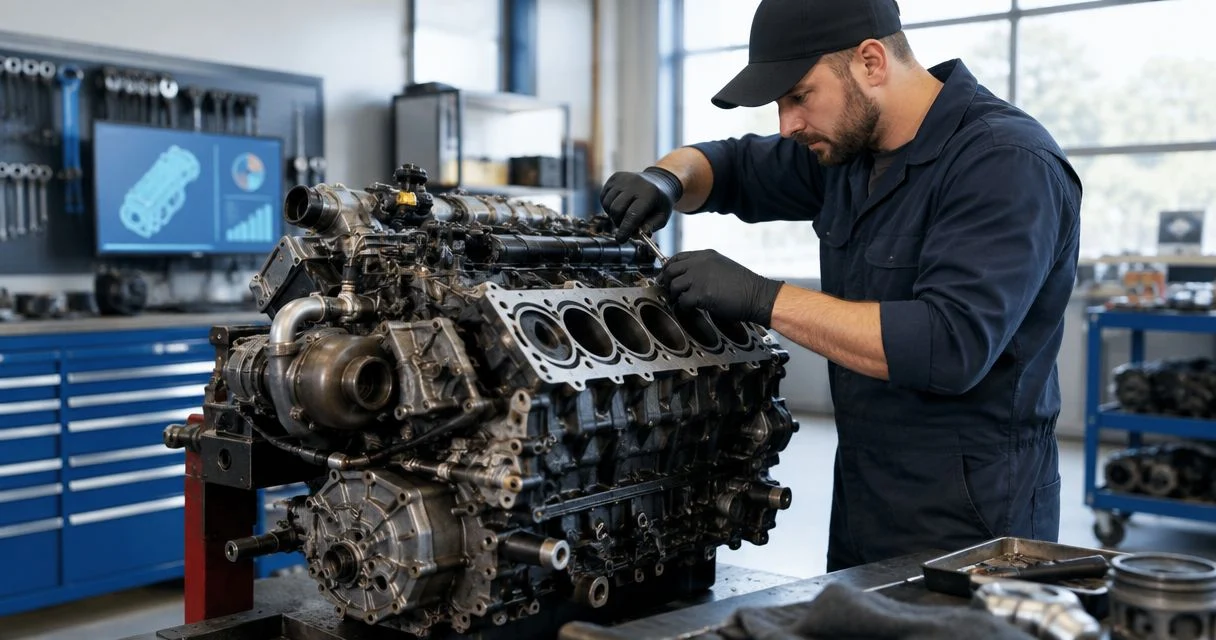
Repairing the current engine can work when damage is limited, and the major castings remain within service limits. This path may include cylinder-head work, component replacement, or correction of a fuel, air, cooling, or lubrication problem before it spreads further.
Install a Rebuilt or Remanufactured Engine
A rebuilt or remanufactured unit can be a practical answer when internal damage is extensive, but the vehicle itself remains valuable. Before buying, confirm the inspection process, machine work, replacement parts, testing, warranty terms, core return requirements, and the expected installation timeline.
Replace or Retire the Vehicle
Replacing the truck may be the better investment when the engine failure is one of several major concerns. Transmission wear, frame corrosion, suspension problems, aging wiring, limited parts support, and poor resale value can make another large repair difficult to justify.
When an Engine Rebuild Makes Sense
A rebuild often makes the most sense when the truck has a solid structure, dependable supporting systems, and a clear future role in the operation. It is especially useful when the fleet already has technicians, diagnostic tools, and familiarity with parts for that engine platform.
- The vehicle still has strong operating or resale value.
- The block, head, and crankshaft can be restored to acceptable specifications.
- The transmission, axles, cooling system, and electrical system are in good condition.
- Parts can be sourced without an unacceptable delay.
- The truck remains well suited to its route, load, and duty cycle.
A proper rebuild addresses the cause of failure, not only the visibly damaged part. Reusing a contaminated oil cooler, a weak injector, a failing turbocharger, or a restricted cooling component can put the repaired engine at risk.
When Full Engine Replacement Is the Better Choice
Full engine replacement may be preferable when damage is widespread, machine work is uncertain, or the vehicle needs to return to service on a predictable schedule. Compatibility is critical. Mounting points, wiring, electronic controls, emissions equipment, accessory drives, gearing, and transmission connections all need confirmation.
Questions to Ask Before Ordering
- Is the engine matched to the truck’s model, application, and control system?
- Which external components transfer from the old engine?
- Are the fuel system, turbocharger, cooling components, and wiring approved for reuse?
- What testing was completed before shipment?
- What does the warranty cover, and does it include labor or towing?
- What installation, break-in, and maintenance steps are required to preserve warranty coverage?
When Retiring the Vehicle May Be Smarter
Keeping an owned truck is not automatically less expensive than replacing it. Consider retirement when recent repair history includes repeated major failures, severe structural corrosion, drivetrain problems, poor fuel economy for the work performed, or limited access to parts and qualified service.
Compare the total repair cost with the cost of another used truck or a newer replacement. Include financing, insurance, registration, taxes, body or equipment transfer, driver training, and time required to place another vehicle into service.
How to Compare the Real Costs
Use a consistent worksheet for every option. Include the engine or repair price, removal and installation labor, fluids, filters, seals, hoses, towing, related component replacement, rental equipment, lost revenue, warranty exclusions, and expected maintenance during the next few years.
Total Decision Cost = Repair Cost + Downtime Cost + Related Repairs + Expected Future Maintenance − Expected Vehicle Value
This is a planning tool rather than a formal accounting formula. Its value is that it prevents a lower estimate from hiding the costs that follow after the truck leaves the shop.
How 2026 Emissions Rules May Affect Planning
Emissions planning should be part of any large vehicle investment. The EPA states that its heavy-duty engine and vehicle standards beginning with model year 2027 set more stringent emissions requirements, so buyers comparing older equipment with newer replacements should review heavy-duty engine and vehicle standards beginning with model year 2027.
Before committing to a repair or replacement, confirm that the vehicle can meet the needs of its intended routes and that the shop can support its diagnostic, emissions, and aftertreatment systems.
The Role of Maintenance Records and Inspections
Maintenance records help identify patterns such as repeated overheating, low oil pressure, rising oil consumption, recurring fault codes, or repeated cooling-system repairs. Oil analysis, coolant results, engine-hour records, inspection reports, and prior invoices can all improve the decision.
For commercial operations, the FMCSA defines a systematic maintenance program as a regular or scheduled effort to keep vehicles in safe operating condition, with intervals determined by the carrier and the vehicle’s needs.
A Step-by-Step Decision Checklist
- Confirm the root cause of failure.
- Identify reusable, repairable, and non-serviceable parts.
- Inspect the frame, drivetrain, suspension, electrical system, and emissions equipment.
- Calculate downtime and substitute-vehicle costs.
- Compare repair, replacement-engine, and replacement-vehicle options.
- Review compatibility, warranty terms, and future service support.
- Document the final decision and the assumptions behind it.
Final Thoughts
A diesel engine failure does not yield a single automatic answer. The strongest decision accounts for the actual engine damage, vehicle condition, downtime exposure, compliance needs, parts support, and expected service life. Carefully comparing rebuild, replacement, and retirement options can protect both the truck and the operation that depends on it.
