



Michael Phelps and Audrey Hepburn never met, and they belonged to different eras, but their life stories speak to the same human themes: talent, discipline, hardship and generosity. Phelps, born in 1985, became the most decorated Olympian in history with 28 medals. Hepburn, born in 1929, rose from a wartime childhood in the Netherlands to win an Academy Award and become a global style and humanitarian symbol. This biography guide explores both lives in clear, chronological detail, from early years to enduring legacy. Whether you are a sports fan, a classic film lover or a student researching famous figures, you will find verified facts and a few surprising parallels here.
Michael Phelps: Early Life and Family Background in Baltimore
Michael Fred Phelps II was born on June 30, 1985, in Baltimore, Maryland, to Fred and Debbie Phelps. He grew up with two older sisters, Whitney and Hilary, in a busy, sports-loving household. His parents divorced when he was nine, and his mother, a school principal, became the steady force in his life. Phelps has often credited her support for keeping him focused during difficult years. The family lived in the suburb of Rodgers Forge, where swimming practice soon became part of the daily routine. Those early years shaped the work ethic, resilience and quiet determination that later defined his Olympic career and his public image as an athlete.
Childhood, ADHD and Finding the Pool
Phelps began swimming at about age seven, partly because his sisters were already competitive swimmers and partly because the pool offered an outlet for his energy. In sixth grade he was diagnosed with ADHD, and swimming helped him channel his focus. He joined the North Baltimore Aquatic Club, where he met coach Bob Bowman, a mentor who would guide him for more than two decades. Bowman recognized his rare combination of stamina, flexibility and competitive drive early on. Phelps trained relentlessly, often swimming six days a week, and he improved at a pace that stunned local coaches. By his early teens he was already breaking national age-group records and attracting national attention.
Michael Phelps’s Olympic Rise: Sydney 2000 and the First World Record
At just 15 years old, Phelps qualified for the 2000 Sydney Olympics, becoming the youngest male member of the U.S. swimming team in 68 years. He finished fifth in the 200-meter butterfly, but the experience lit a fire. In 2001, at 15 years and nine months, he set a world record in the same event, becoming the youngest male swimmer ever to do so. The achievement announced a new star in the sport. Over the next three years he added multiple world titles and records, and expectations grew steadily. Phelps was no longer a promising teenager; he was a serious threat to rewrite swimming history.
Athens 2004: Six Golds and a Global Breakthrough
At the 2004 Athens Games, a 19-year-old Phelps entered an ambitious program of events and won six gold medals and two bronze medals, eight medals in total. His golds came in the 100-meter butterfly, 200-meter butterfly, 200-meter individual medley, 400-meter individual medley, and two relays. He fell short of Mark Spitz’s record of seven golds in a single Games, but the performance made him an international name. Athens also showed his versatility, since he competed across butterfly, freestyle and medley disciplines. Many observers saw it as the beginning of a new era, and the bigger ambition of matching Spitz now felt realistic.
Beijing 2008: Eight Gold Medals and a Historic Record
The 2008 Beijing Olympics produced the defining moment of Phelps’s career. He won eight gold medals in a single Games, breaking Mark Spitz’s record of seven set in 1972. Seven of those victories came with world records. The most dramatic was the 100-meter butterfly, which he won by 0.01 seconds over Serbia’s Milorad Čavić, a margin so small that it still stirs debate and admiration. His relay teammates also delivered, notably in the 4×100-meter freestyle, where Jason Lezak’s final leg saved the gold. Beijing turned Phelps into a household name worldwide, and the images of him on the podium remain some of the most recognizable in Olympic history.
London 2012, Retirement and the Rio 2016 Comeback
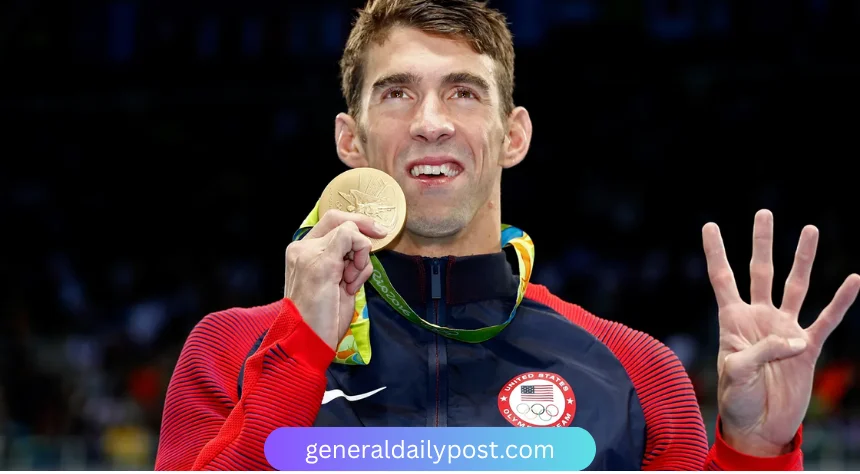
After London 2012, where Phelps won four golds and two silvers, he announced his retirement. He returned to competition in 2014, but his comeback was interrupted by a DUI arrest in September of that year, which led to a suspension and a period of reflection and treatment. He recovered, qualified for the 2016 Rio Games, and was chosen as the U.S. flag bearer at the opening ceremony. In Rio he added five golds and one silver, bringing his career total to 28 Olympic medals: 23 gold, three silver and two bronze. He retired again, leaving a record that many experts consider almost impossible to surpass.
Michael Phelps’s Mental Health Advocacy and Family Life
Off the pool deck, Phelps became known for speaking openly about depression and anxiety, including a very dark period after the 2012 Games. His candor, including his role in the 2020 HBO documentary The Weight of Gold, helped reduce stigma around athlete mental health. He established the Michael Phelps Foundation in 2008 to promote water safety and healthy living, and he has partnered with mental health organizations to expand access to therapy. In 2016 he married Nicole Johnson, and the couple have since built a family together. Today he works as a speaker, mentor and television commentator, showing that life after sport can carry just as much purpose.
Audrey Hepburn: Early Life and Wartime Childhood in Europe
Audrey Kathleen Ruston, later known as Audrey Hepburn, was born on May 4, 1929, in Ixelles, Brussels, Belgium. Her father, Joseph Ruston, was a British businessman, and her mother, Baroness Ella van Heemstra, came from Dutch nobility. Her parents separated when she was six, and her father’s departure left a lasting emotional mark. She attended boarding school in England before her mother moved her to Arnhem, Netherlands, in 1939, hoping the country would stay neutral. Instead, Germany invaded in 1940. Hepburn lived through the occupation and the severe Hunger Winter of 1944–45, experiences that deeply shaped her character and later her compassion for suffering children.
Ballet Dreams and the Move to London
During the war, Hepburn studied ballet and, according to biographers, performed secret recitals to raise money for the Dutch resistance. After liberation in 1945, she resumed training in Amsterdam and moved to London in 1948 on a ballet scholarship with Marie Rambert. She learned that, at her height, a career as a leading ballerina was unlikely, so she turned to the stage and screen. She worked as a chorus girl in West End musicals such as High Button Shoes and took small film roles, including Dutch in Seven Lessons. These modest jobs gave her professional discipline and brought her first notice from casting agents.
Audrey Hepburn’s Hollywood Breakthrough: From Gigi to Roman Holiday
Hepburn’s big break arrived in 1951, when French novelist Colette personally chose her to play the title role in the Broadway adaptation of Gigi. Hollywood soon noticed. Director William Wyler cast her as a runaway princess opposite Gregory Peck in Roman Holiday (1953), a role that made her an international star almost overnight. Peck insisted her name appear beside his on the billing after seeing her talent. Critics praised her charm, natural grace and warmth, qualities that set her apart from the glamorous stars of the era. The film positioned Hepburn as a new kind of leading lady, elegant yet relatable.
Oscar, Tony and EGOT Success
Hepburn won the Academy Award for Best Actress in 1954 for Roman Holiday, along with the Golden Globe and BAFTA. In the same year she won a Tony Award for her Broadway performance in Ondine, a rare double triumph. She received further Oscar nominations for Sabrina, The Nun’s Story, Breakfast at Tiffany’s and Wait Until Dark. After her death, she also earned a Grammy and an Emmy, placing her among the small group of EGOT winners. Her awards reflect not only talent but also her versatility across comedy, romance, drama and thriller roles. Few performers of her generation matched that range, and fewer still did so while keeping such a graceful public image.
Iconic Roles and Style: Breakfast at Tiffany’s to My Fair Lady
Hepburn’s filmography reads like a classic cinema syllabus. Sabrina (1954), Funny Face (1957), Breakfast at Tiffany’s (1961), Charade (1963) and My Fair Lady (1964) showcased her range and screen magnetism. Her partnership with designer Hubert de Givenchy produced the black dress of Breakfast at Tiffany’s, one of the most famous costumes in film history. Her look, with short dark hair, bold brows and simple tailoring, helped define mid-century elegance. She also took serious roles, notably in The Nun’s Story (1959), proving she could deliver emotional depth beyond glamour. Her late work includes Robin and Marian (1976), a gentle romance opposite Sean Connery, and a brief role in Always (1989).
Audrey Hepburn’s Humanitarian Work with UNICEF
In 1988, Hepburn became a Goodwill Ambassador for UNICEF, an organization that had aided her during the postwar years. She traveled to places including Ethiopia, Sudan, Bangladesh, Vietnam and Somalia, meeting children facing hunger and disease and urging governments to act. Her approach was practical, humble and persistent. She raised funds, spoke with leaders and drew media attention to crises that were often overlooked. In 1992, President George H. W. Bush awarded her the Presidential Medal of Freedom, and in 1993 she was honored posthumously with the Jean Hersholt Humanitarian Award. For many admirers, this chapter of her life matters even more than her film career.
Final Years, Family and Enduring Legacy
Hepburn married actor Mel Ferrer in 1954 and had a son, Sean, in 1960; after their divorce she married Italian psychiatrist Andrea Dotti and had a second son, Luca, in 1970. In her later years she shared her life with Dutch actor Robert Wolders. She died on January 20, 1993, in Tolochenaz, Switzerland, at age 63, from a rare form of abdominal cancer. Her legacy lives on through the Audrey Hepburn Children’s Fund and countless fashion homages. Her image, her films and her humanitarian example continue to inspire new generations around the world. Museums, exhibitions and biographies still celebrate her life more than three decades after her passing.
Michael Phelps and Audrey Hepburn: Surprising Parallels Between Two Legends
Although separated by decades and professions, Michael Phelps and Audrey Hepburn share striking similarities. Both began with childhood challenges, whether ADHD or wartime hunger, and both found structure through disciplined practice, one in the pool and the other at the ballet barre. Each reached global fame at a young age and learned to manage it with the help of trusted allies, such as Bob Bowman and Hubert de Givenchy. Perhaps most importantly, both used their platforms to help others, Phelps through mental health advocacy and Hepburn through UNICEF. These parallels make the pairing a useful lens for studying fame, resilience and purpose.

Lessons from Michael Phelps and Audrey Hepburn for Today’s Readers
The stories of Michael Phelps and Audrey Hepburn offer practical lessons that apply well beyond sport or cinema. First, talent grows through consistency: Phelps’s endless training laps and Hepburn’s years of ballet both built the foundation for later success. Second, vulnerability is a strength; Phelps’s openness about mental health and Hepburn’s honesty about her wartime hardships made them more relatable. Third, success gains meaning when shared, as the Michael Phelps Foundation and UNICEF work show. Finally, reinvention is possible. Phelps returned from retirement and personal setbacks, while Hepburn moved from dancer to actress to humanitarian. Their journeys remind readers that growth rarely follows a straight line.
Conclusion
Michael Phelps and Audrey Hepburn represent two different kinds of greatness, one measured in medals and records, the other in memorable performances and compassion. Phelps transformed swimming, finishing with 28 Olympic medals and later becoming a leading voice for mental health. Hepburn redefined screen elegance, won an Oscar at 24, and devoted her final years to UNICEF. Their biographies show that extraordinary achievement often begins with ordinary struggles and grows through discipline, mentorship and purpose. For readers seeking inspiration, these two lives offer a reminder that excellence matters most when it is used to uplift others. Whether you admire the athlete or the actress, their legacies deserve to be remembered and shared.
Frequently Asked Questions (FAQs)
1. Are Michael Phelps and Audrey Hepburn related? No. They were never related and never met. Hepburn died in 1993, when Phelps was seven years old. They are compared here only for their shared values and lasting influence.
2. How many Olympic medals did Michael Phelps win? Phelps won 28 Olympic medals between 2000 and 2016: 23 gold, three silver and two bronze, the most of any Olympian in history.
3. When was Audrey Hepburn born and when did she die? She was born on May 4, 1929, in Brussels, Belgium, and died on January 20, 1993, in Tolochenaz, Switzerland, at age 63.
4. What is Audrey Hepburn best known for? She is best known for Roman Holiday (Oscar-winning), Breakfast at Tiffany’s, Charade and My Fair Lady, as well as her humanitarian work with UNICEF.
5. What is Michael Phelps doing now? Phelps is active as a mental health advocate, speaker and swimming commentator, and he continues his foundation work. Check his official channels for the latest updates.
6. Why are Michael Phelps and Audrey Hepburn often discussed together? Both are icons in their fields who overcame early challenges through discipline and later used their fame to support others, making them popular subjects for inspirational biography content.
