


Kitchens have always been the heart of the home, and nowhere has this idea evolved as dramatically as in China Kitchen Design. From ancient courtyard cooking spaces to today’s high-tech, export-ready cabinetry systems, China has become one of the world’s most influential forces in kitchen manufacturing and design. This guide walks through the history, materials, styles, and future direction of China Kitchen Design, offering homeowners, architects, and B2B buyers a complete picture of why “Made in China” kitchens now furnish homes across the globe. Whether you’re sourcing cabinetry or simply curious about the industry, this article covers everything you need to know.
What Is China Kitchen Design?
China Kitchen Design refers to the design philosophy, manufacturing processes, and stylistic traditions behind kitchens produced in China — both for the domestic market and for global export. It encompasses everything from cabinet construction and material selection to layout planning and cultural aesthetics. Unlike a single fixed style, China Kitchen Design today represents a broad spectrum: traditional Chinese layouts rooted in Feng Shui, minimalist modern kitchens influenced by international trends, and fusion designs blending Eastern function with Western form. Understanding this term means understanding both a design culture and a massive global manufacturing industry that supplies kitchens to markets in North America, Europe, the Middle East, and beyond.
The Origins of China Kitchen Design
Kitchen design in China did not begin with cabinetry catalogs — it began with necessity, climate, and family structure. Traditional Chinese homes organized the kitchen as a separate, functional room, distinct from living and sleeping quarters, often positioned according to directional principles believed to bring balance and good fortune. Cooking methods centered on the wok, open flames, and steaming, which shaped the physical layout long before “design” became a formal discipline. These early spatial habits — ventilation-first planning, closed storage, and separation of wet and dry zones — remain embedded in China Kitchen Design principles used by manufacturers today, even in ultra-modern factory-built units.
Traditional Chinese Kitchen Layouts
Traditional layouts prioritized efficiency and hierarchy. The stove, often wood- or coal-fired, sat at the center of activity, with prep areas and water storage arranged around it. Because extended families frequently shared one kitchen, generous counter space and multiple storage tiers became standard. This tradition of maximizing function within compact square footage directly influences the space-saving cabinetry solutions that Chinese manufacturers now export worldwide, proving that centuries-old layout logic still informs contemporary kitchen design in China.
Influence of Feng Shui on Kitchen Design
Feng Shui — the ancient practice of arranging spaces to promote harmony and positive energy flow — has long shaped Chinese kitchen planning. Under Feng Shui principles, the stove should never directly face the main door, water and fire elements (sink and stove) should be separated, and the kitchen should avoid sitting directly beneath a bathroom. While modern Chinese manufacturers don’t always market Feng Shui explicitly, these spatial rules still quietly guide layout recommendations given to homeowners and interior designers, making Feng Shui one of the most enduring cultural threads in China Kitchen Design.
The Rise of China as a Global Kitchen Manufacturing Hub
China’s transformation into a kitchen manufacturing powerhouse is closely tied to its broader industrial and economic reforms. What began as small, regional woodworking workshops evolved into an export-driven ecosystem capable of supplying entire nations with cabinetry, countertops, and modular kitchen systems. Today, China Kitchen Design and manufacturing represents one of the largest segments within the country’s furniture export economy, supported by dedicated industrial clusters, specialized trade fairs, and decades of accumulated craftsmanship passed down through generations of factory-trained artisans.
Post-1980s Industrial Growth
Following China’s economic reforms beginning in 1978, manufacturing regions such as Guangdong, Zhejiang, and Fujian developed into furniture and cabinetry production hubs. Factories that once produced basic wooden furniture gradually adopted specialized kitchen cabinetry lines, responding to rising domestic urbanization and growing housing demand. This period marked the true beginning of organized, scalable China Kitchen Design production, moving the industry away from small workshops toward factory-based, standardized manufacturing capable of meeting both local and international order volumes.
China’s Entry into Global Trade (WTO, 2001)
China’s accession to the World Trade Organization in 2001 proved to be a turning point for the kitchen manufacturing sector. Lower trade barriers and improved international logistics allowed Chinese factories to expand aggressively into export markets, supplying kitchen cabinets, countertops, and fittings to retailers and builders across the world. This period cemented China’s reputation as a cost-effective, quality-improving source for kitchen products, and China Kitchen Design began appearing not just in domestic apartments but in showrooms across the U.S., U.K., Australia, and the Middle East.
Evolution of Kitchen Cabinet Materials in China
Material innovation has been central to the evolution of China Kitchen Design. Early kitchens relied almost entirely on solid wood, which, while durable, was costly and less adaptable to mass production. As the industry matured, manufacturers introduced engineered wood products, laminates, and composite panels that offered better consistency, lower costs, and improved moisture resistance — a critical factor in humid kitchen environments. This shift allowed Chinese factories to scale production dramatically while maintaining acceptable durability standards, making cabinetry more affordable for both domestic buyers and international importers seeking cost-competitive kitchen solutions.
From Wood to Engineered Panels
Modern Chinese kitchen factories now commonly use MDF (medium-density fiberboard), particleboard, and plywood as base materials, finished with melamine, PVC foil, or lacquer coatings. These engineered panels offer dimensional stability, resist warping, and allow for consistent finishes across large production runs — something solid wood struggles to match at scale. This transition didn’t eliminate solid wood entirely; premium China Kitchen Design lines still offer solid oak, walnut, or bamboo options for buyers seeking a higher-end finish, giving the market a tiered structure from budget to luxury.
The Shift Toward Eco-Friendly Materials
In recent years, environmental regulations and consumer demand have pushed manufacturers toward low-formaldehyde boards, water-based lacquers, and certified sustainable wood sourcing. Many factories now pursue certifications aligned with international environmental standards to remain competitive in export markets like the EU and North America, where eco-compliance is often a purchasing requirement. This growing emphasis on sustainability has become a defining feature of contemporary China Kitchen Design, reflecting the industry’s response to both regulatory pressure and rising global awareness around indoor air quality and environmental responsibility.
Popular China Kitchen Design Styles
China’s kitchen manufacturing sector doesn’t produce just one look — it produces an entire spectrum of styles tailored to different markets, budgets, and buyer preferences. From ultra-minimalist urban apartments to ornately detailed traditional-inspired spaces, China Kitchen Design today caters to a wide range of aesthetic tastes. This diversity is one of the reasons Chinese manufacturers have succeeded internationally: factories are equipped to customize finishes, hardware, and layouts to match regional design trends, whether that’s Scandinavian minimalism, American shaker-style cabinetry, or contemporary Chinese fusion.
Modern Minimalist Chinese Kitchens
Reflecting global minimalist trends, many contemporary Chinese kitchens favor clean lines, handleless cabinets, neutral color palettes, and integrated appliances. This style prioritizes uncluttered visual space and functional storage systems, often incorporating soft-close hinges, pull-out organizers, and hidden compartments. Popular in urban apartments across cities like Shanghai and Shenzhen, this minimalist approach has also become one of the most exported styles, appealing to international buyers who want sleek, low-maintenance kitchen aesthetics without sacrificing storage efficiency.
Classic Chinese-Inspired Kitchens
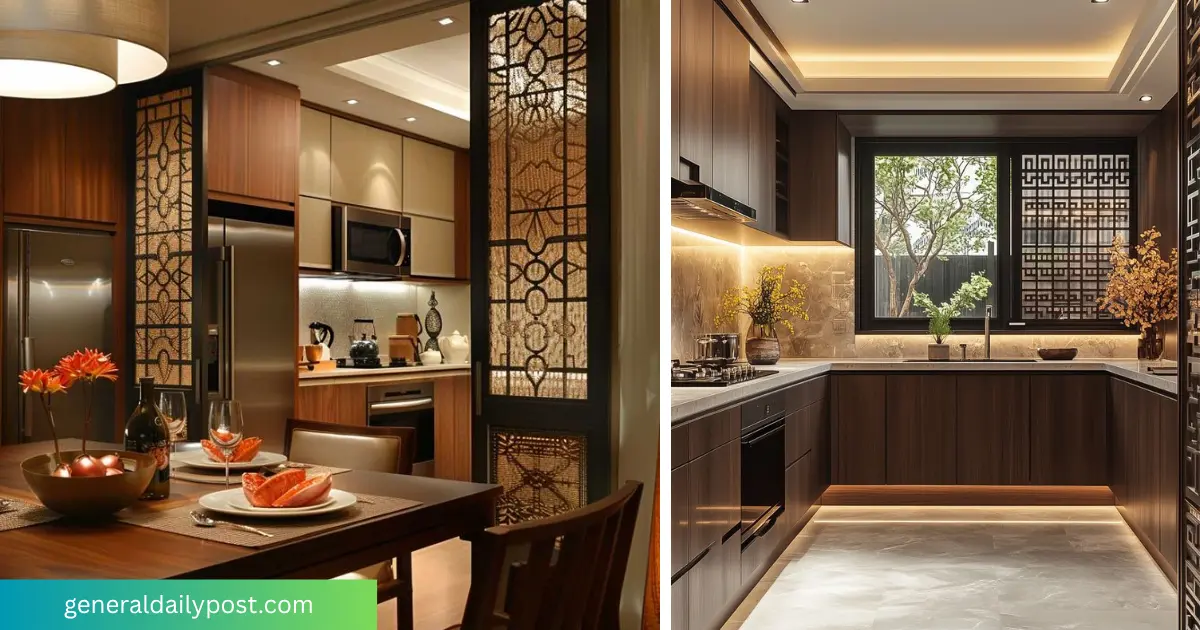
For buyers seeking cultural character, classic Chinese-inspired kitchens incorporate elements like lattice-patterned cabinet doors, warm wood tones, and traditional color accents such as red or gold detailing. These designs often nod to historic Chinese architecture while integrating modern appliances and storage technology. Though less common in mass export markets, this style remains popular in high-end residential projects and hospitality settings, such as boutique hotels or restaurants aiming to evoke a distinctly Chinese cultural atmosphere within a fully functional, modern kitchen space.
Fusion Kitchen Designs (East Meets West)
Fusion kitchens blend traditional Chinese functionality with Western stylistic elements, creating hybrid spaces that appeal to global buyers. A fusion kitchen might pair a Western-style island counter with Feng Shui-informed stove placement, or combine European cabinet hardware with Chinese lacquer finishes. This style has grown significantly as Chinese manufacturers work directly with international designers and retailers, tailoring products for specific markets. Fusion design represents the most commercially significant branch of China Kitchen Design today, driving much of the country’s cabinetry export revenue.
Key Features of Chinese Kitchen Cabinetry
Regardless of stylistic direction, several features consistently define quality China Kitchen Design cabinetry: modular construction for easy shipping and assembly, moisture-resistant coatings, soft-close drawer and door mechanisms, and customizable sizing to fit varying kitchen dimensions. Many manufacturers also offer flat-pack shipping, reducing freight costs for international buyers. Hardware quality — hinges, sliders, and handles — has improved significantly over the past decade, with many factories now sourcing or manufacturing components that meet international durability standards, helping shed the outdated perception that Chinese cabinetry sacrifices quality for cost.
China Kitchen Design in the Global Market
China’s dominance in kitchen cabinetry export is not accidental — it’s the result of integrated supply chains, competitive labor costs, and continuous investment in manufacturing technology. Buyers from furniture retailers to construction developers increasingly turn to Chinese factories for both finished kitchen units and private-label manufacturing. This global reach has made China Kitchen Design synonymous not just with a stylistic category, but with an entire cross-border industry supplying millions of homes annually, from budget housing developments to luxury residential towers.
Export Trends and Major Manufacturing Regions
Key manufacturing clusters like Guangdong, Shandong, and Jiangsu host thousands of cabinetry factories, many specializing in specific export markets. Guangdong province, in particular, has become closely associated with furniture and cabinetry exports due to its port access and manufacturing infrastructure. These regions often host specialized trade fairs, connecting international buyers directly with factories, streamlining the sourcing process for importers seeking reliable, scalable kitchen cabinetry production partners.
OEM/ODM Kitchen Cabinet Manufacturing
A major driver of China’s kitchen export success is its OEM (Original Equipment Manufacturer) and ODM (Original Design Manufacturer) capabilities. International brands frequently partner with Chinese factories to produce kitchens under their own branding, using either the brand’s design specifications (OEM) or the factory’s in-house design team (ODM). This flexibility allows retailers worldwide to offer competitively priced kitchen products without operating their own manufacturing facilities, further embedding China Kitchen Design into global supply chains.
Technology and Innovation in China Kitchen Design
Modern Chinese kitchen factories have invested heavily in automation, precision manufacturing, and smart-home integration. This technological evolution has allowed the industry to move beyond simple cost competitiveness into genuine innovation, positioning China Kitchen Design as a leader not just in volume, but increasingly in manufacturing sophistication and product intelligence.
Smart Kitchen Integration
Smart technology — including app-controlled lighting, integrated charging stations, and sensor-based storage systems — is becoming more common in higher-end Chinese kitchen lines. As smart home adoption grows domestically and internationally, manufacturers are incorporating these features directly into cabinetry design rather than treating them as separate add-ons, giving buyers more connected, tech-forward kitchen environments straight out of the factory.
CNC and Automated Manufacturing
CNC (Computer Numerical Control) machining has transformed precision and consistency in Chinese cabinet production, allowing for exact cuts, consistent joinery, and reduced material waste. Combined with automated finishing lines, this technology enables factories to produce large volumes without sacrificing accuracy, a critical factor for export orders that require consistent quality across thousands of units shipped internationally.
Sustainability in Modern China Kitchen Design
Environmental responsibility has become an increasingly important pillar of China Kitchen Design. Manufacturers are adopting low-VOC finishes, sustainably sourced timber, and energy-efficient production processes to meet both regulatory requirements and evolving consumer expectations. This shift isn’t purely about compliance — international buyers, particularly in Europe and North America, increasingly favor suppliers who can demonstrate genuine environmental accountability, making sustainability a competitive differentiator rather than just a checkbox for many manufacturers today.
How to Choose a China Kitchen Design Manufacturer
Selecting the right manufacturer requires evaluating several factors: material quality certifications, production capacity, customization flexibility, and export experience. Buyers should request material safety documentation, review factory audit reports where possible, and confirm whether the manufacturer offers OEM, ODM, or both. Communication capability and English-language support also matter significantly for smooth international transactions. Working with manufacturers who have verifiable trade show presence or established export histories generally reduces risk for first-time international buyers entering the China Kitchen Design sourcing process.
Future Trends in China Kitchen Design
Looking ahead, China Kitchen Design is expected to lean further into sustainability, smart integration, and hyper-customization. As global consumers demand more personalized products, factories are investing in flexible production systems capable of small-batch customization without sacrificing the cost advantages of mass manufacturing. Expect continued growth in eco-certified materials, deeper smart-home compatibility, and expanded fusion styles blending international aesthetics with Chinese manufacturing efficiency — solidifying China’s role not just as a manufacturing base, but as a genuine design influence shaping kitchens worldwide.
Conclusion
China Kitchen Design has evolved from ancient courtyard cooking spaces shaped by Feng Shui and family tradition into a sophisticated global manufacturing industry supplying homes across continents. Its journey — through post-1978 industrial reform, WTO accession, material innovation, and technological advancement — reflects both cultural heritage and remarkable economic transformation. Today’s Chinese kitchen manufacturers offer everything from minimalist modern cabinetry to culturally rich, classic-inspired designs, backed by increasingly sustainable practices and smart technology. For homeowners, designers, and international buyers alike, understanding this evolution offers valuable insight into why “Made in China” kitchens continue to shape modern living spaces around the world.
FAQs
1. What makes China Kitchen Design different from Western kitchen design? China Kitchen Design blends traditional cultural principles like Feng Shui with modern manufacturing efficiency, often emphasizing modular, space-saving layouts suited to varied home sizes and export flexibility.
2. Are Chinese kitchen cabinets good quality? Quality varies by manufacturer, but many established factories now meet international durability and safety standards, especially those serving export markets in Europe and North America.
3. What materials are commonly used in Chinese kitchen cabinetry? Common materials include MDF, particleboard, plywood, and increasingly, eco-certified solid wood options finished with melamine, PVC foil, or lacquer coatings.
4. Is Feng Shui still used in modern Chinese kitchen design? Yes, many layout recommendations, such as stove and sink placement, still reflect traditional Feng Shui principles even in contemporary designs.
5. Why is China a major exporter of kitchen cabinets? Competitive manufacturing costs, integrated supply chains, OEM/ODM flexibility, and improved trade access following WTO membership have made China a leading global kitchen cabinetry exporter.
6. What should I look for when sourcing kitchens from Chinese manufacturers? Look for material safety certifications, verified export experience, customization capability, and clear communication support to ensure a smooth international sourcing process.
7. Is China Kitchen Design moving toward sustainability? Yes, many manufacturers now use low-formaldehyde boards, water-based finishes, and sustainably sourced materials to meet global environmental standards and buyer expectations.
