


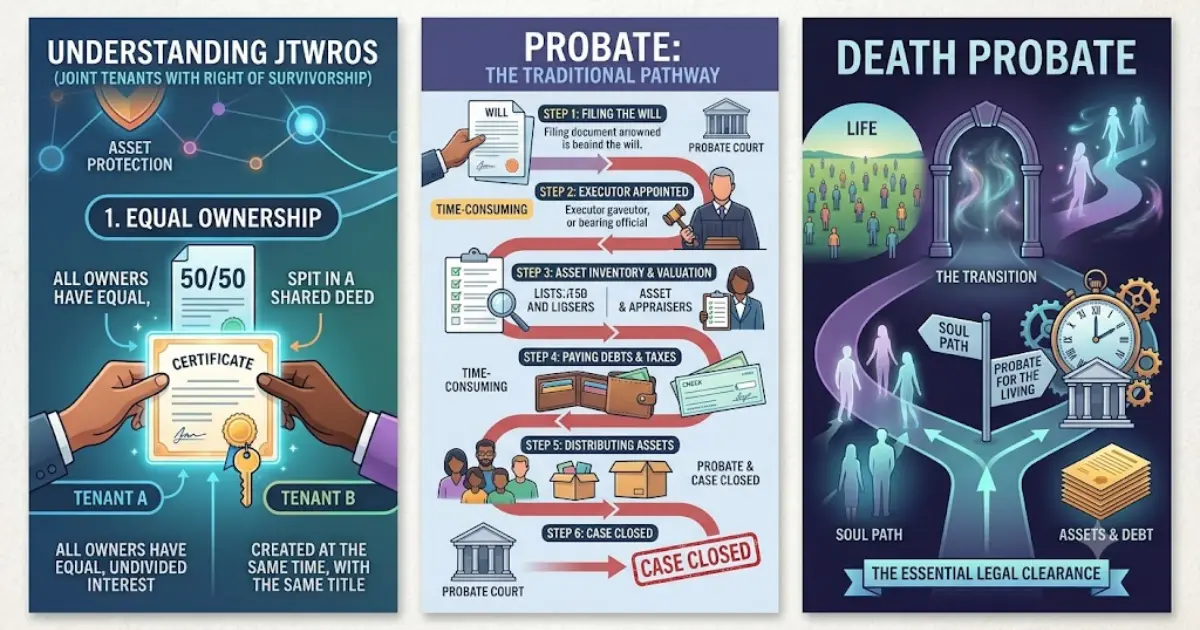
If you’ve ever looked at a property deed, bank statement, or brokerage account and seen the letters JTWROS printed after your name, you’ve probably wondered what it actually means. JTWROS stands for Joint Tenants With Right of Survivorship, one of the most common — and most misunderstood — forms of shared ownership in the United States. It affects homes, checking accounts, investment portfolios, and even vehicles. Understanding JTWROS matters because it can override your will, trigger unexpected tax consequences, and determine exactly who inherits your assets the moment you pass away. This guide breaks down everything you need to know about JTWROS, from its legal basis to its real-world pros, cons, and alternatives.
What Does JTWROS Stand For?
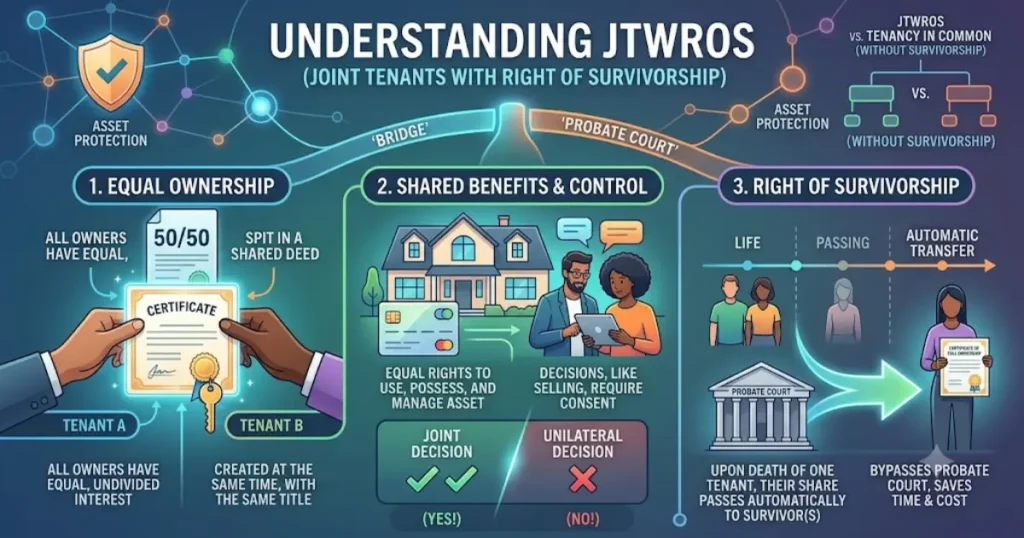
JTWROS is a legal acronym that stands for “Joint Tenants With Right of Survivorship.” In plain terms, it describes an ownership arrangement where two or more people hold equal shares in a single asset, and when one owner dies, their share automatically transfers to the surviving owner or owners. This happens instantly and outside of the probate court system, which is the main reason people choose this structure. You’ll typically see JTWROS listed on real estate deeds, joint bank accounts, brokerage statements, and even car titles. It’s a title designation, not a separate legal document, meaning the words themselves carry binding legal weight the moment they appear on an official record.
The Legal Meaning Behind Joint Tenancy
To fully grasp JTWROS meaning, it helps to understand the broader concept of joint tenancy itself. Joint tenancy is a legal arrangement where co-owners hold identical, undivided interests in a shared asset. Unlike a partnership where shares can differ, joint tenants each own an equal portion, regardless of how many people are on the title. This form of ownership is popular among married couples, siblings, business partners, and unmarried partners who want a simple, low-cost way to share property. Because the right of survivorship is built directly into the ownership structure, there’s no need for a separate legal filing when an owner passes away — the transfer happens automatically under state property law.
The “Four Unities” Requirement
For a JTWROS arrangement to be legally valid, most states require what’s known as the “four unities”: time, title, interest, and possession. This means all co-owners must acquire their ownership interest at the same time, through the same deed or document, with an equal share of interest, and with equal rights to use and possess the property. If any of these four unities is missing — for example, if one owner joined the title years after the others — the arrangement may legally default to a different ownership type, such as tenancy in common. This technical requirement is often overlooked by everyday property owners but is critical for lawyers and title companies verifying that a JTWROS designation will actually hold up.
How JTWROS Differs From Tenancy in Common
The most common point of confusion is the difference between JTWROS and Tenants in Common (TIC). Under a TIC arrangement, each co-owner holds a separate, distinct share of the property, which can even be unequal (for example, a 70/30 split). When a TIC owner dies, their share does not pass automatically to the other owners — instead, it goes through probate and is distributed according to their will or state inheritance laws. Under JTWROS, by contrast, the surviving owner or owners automatically inherit the deceased’s share, bypassing probate entirely. This single distinction — automatic survivorship versus probate transfer — is the defining difference between the two ownership structures.
Where You’ll Commonly See JTWROS
JTWROS isn’t limited to real estate. It shows up across many types of assets people share with a partner, relative, or business associate. Common examples include:
- Real estate, including primary homes, vacation properties, and land
- Bank accounts, such as joint checking and savings accounts
- Brokerage and investment accounts, including stocks and mutual funds
- Vehicles, where a car title lists two owners as JTWROS
- Business assets, when partners co-own equipment or property
Each of these asset types benefits from the same core feature: when one titled owner dies, ownership passes directly and automatically to the survivor, without court involvement.
Why People Choose JTWROS
The biggest draw of a JTWROS arrangement is avoiding probate. Probate can be a slow, costly, and public legal process that ties up assets for months or even years after someone dies. By titling property as JTWROS, couples and family members ensure that ownership transfers immediately and privately to the survivor, with no court petition required. This is especially appealing for married couples and long-term partners who want a guaranteed, hassle-free way to keep shared assets accessible. It’s also popular with elderly parents who add an adult child to a bank account so bills can continue to be paid smoothly if the parent becomes incapacitated or passes away.
The Downsides of JTWROS You Should Know
While JTWROS offers simplicity, it comes with real trade-offs. First, a JTWROS designation overrides your will. Even if your will states that an asset should be split three ways among your children, a JTWROS account naming only one child will pass entirely to that child, regardless of what the will says. Second, all co-owners are equally responsible for debts tied to the asset, such as mortgage payments — if one owner can’t pay, the others must cover the shortfall. Third, no owner can sell or transfer their share without the consent of the other co-owners. These restrictions make JTWROS far less flexible than sole ownership or a properly funded trust.
JTWROS and Estate Planning Conflicts
One of the most serious risks of JTWROS is how it can quietly undermine an otherwise well-planned estate. Consider a parent with three children who wants assets split evenly. If that parent adds only one child as a joint owner on a bank account — often just so that child can help pay bills — the entire account balance goes to that one child upon the parent’s death, no matter what the will says. The other siblings receive nothing from that account, since it never passes through probate and therefore isn’t governed by the will at all. Estate attorneys frequently warn clients that this mismatch between stated intentions and actual account titling is one of the most common causes of family disputes after a death.
Tax Implications of JTWROS
JTWROS can also carry tax consequences that surprise many families. When you add a non-spouse to a title as a joint owner, the IRS may treat this as a gift of half the asset’s value, potentially triggering gift tax filing requirements if it exceeds the annual exclusion. Additionally, JTWROS properties don’t always receive the same favorable “stepped-up basis” treatment that assets passing through a will or trust receive. This means that when the surviving owner eventually sells the property, they could owe capital gains tax on a much larger portion of the appreciation than they would under a different ownership structure. Anyone considering JTWROS for significant assets should consult a tax professional or estate attorney first.
JTWROS for Married Couples: Tenancy by the Entirety
Some states offer a specialized version of JTWROS exclusively for married couples, called “Tenancy by the Entirety.” This arrangement functions similarly to standard JTWROS — with automatic survivorship — but adds extra creditor protection, since one spouse’s individual creditors generally cannot force the sale of the jointly held property. Not every state recognizes tenancy by the entirety, so it’s important to check your state’s specific property laws before assuming this protection applies. For couples in states that do allow it, this option often provides a stronger layer of financial security than a standard JTWROS deed while still preserving the core survivorship benefit.
What Happens if Both Owners Die Simultaneously?
A lesser-known aspect of JTWROS involves what happens if co-owners pass away at the same time, such as in an accident. In these rare cases, the automatic survivorship feature can’t apply since there’s no surviving owner to inherit the asset. When this occurs, the property typically does go through probate, and a Transfer on Death (TOD) designation, if one was set up in advance, may determine the next beneficiary. This is why estate planning attorneys often recommend pairing JTWROS titling with a backup TOD or beneficiary designation, ensuring there’s a clear line of succession even in the unlikely event that all joint owners die together.
Removing a Joint Tenant From a JTWROS Title
Another important detail is that JTWROS ownership cannot be unilaterally changed. If you want to remove a co-owner from a JTWROS deed or account, you generally need that person’s written consent and signature. This protects all parties from having their ownership stripped without agreement, but it also means disputes between joint owners can become legally complicated. In some cases, one owner can “sever” the joint tenancy by transferring their interest to themselves through a new deed, converting the arrangement into a tenancy in common — but this typically requires legal assistance and varies by state law.
JTWROS vs. Living Trusts: Which Is Better?
Many financial advisors compare JTWROS to placing assets in a revocable living trust, since both strategies aim to avoid probate. A living trust offers more flexibility and control, allowing you to specify exactly how assets are distributed, name multiple successor beneficiaries, and adjust terms at any time. JTWROS, on the other hand, is simpler and cheaper to set up but far less adaptable — once you add a joint owner, you’re largely locked into that arrangement. For smaller estates or straightforward married-couple situations, JTWROS is often sufficient. For larger, more complex estates involving multiple beneficiaries or specific conditions, a trust is usually the stronger choice.
Common Mistakes People Make With JTWROS
Many people set up JTWROS accounts without realizing the full legal weight of the designation. A frequent mistake is adding an adult child to a bank account purely for convenience — so they can help pay bills — without understanding that doing so makes that child a legal co-owner entitled to the entire balance upon the parent’s death. Another common error is assuming a will can override a JTWROS title; it cannot. Some people also mistakenly believe JTWROS avoids all future probate, when in reality it only delays probate until the last surviving owner passes away. Consulting an estate planning attorney before setting up joint accounts helps avoid these costly missteps.
How to Set Up a JTWROS Arrangement
Establishing JTWROS ownership is relatively straightforward. For real estate, the deed must explicitly state that owners hold title as “joint tenants with right of survivorship” — simply listing two names isn’t enough, since many states default to tenancy in common without this specific language. For bank and brokerage accounts, the financial institution typically provides a form where you select JTWROS as the account type when opening it or converting an existing account. Vehicle titles follow a similar process through your state’s department of motor vehicles. In every case, it’s worth confirming the paperwork explicitly uses the correct legal wording, since vague or incomplete language can invalidate the intended survivorship protection.
Conclusion
JTWROS, or Joint Tenants With Right of Survivorship, offers a simple, cost-effective way for two or more people to co-own property, bank accounts, or investments while guaranteeing that ownership transfers automatically to the survivor without probate. It’s especially popular among married couples and close family members seeking a quick, low-cost estate planning tool. However, JTWROS isn’t without risk — it can override a will, create unintended tax consequences, and lock owners into shared financial responsibility. Before titling any significant asset as JTWROS, it’s wise to weigh the pros and cons against alternatives like tenancy in common or a living trust, and to consult an estate planning attorney to ensure the arrangement truly matches your long-term goals.
Frequently Asked Questions (FAQs)
1. What does JTWROS stand for? JTWROS stands for “Joint Tenants With Right of Survivorship,” a form of shared ownership where a deceased owner’s share automatically passes to the surviving co-owner(s).
2. Does JTWROS avoid probate? Yes, JTWROS avoids probate when the first co-owner dies, since ownership transfers automatically. However, probate may still be required after the last surviving owner passes away, unless further planning is done.
3. Can a will override a JTWROS designation? No. A JTWROS title takes legal precedence over a will. Even if a will states different distribution wishes, the surviving joint owner still receives the asset automatically.
4. What’s the difference between JTWROS and Tenants in Common? Under JTWROS, ownership passes automatically to survivors. Under Tenants in Common (TIC), a deceased owner’s share goes through probate and is distributed according to their will.
5. Are there tax downsides to JTWROS? Yes. Adding a non-spouse as a joint owner can trigger gift tax considerations, and JTWROS assets may not receive the same stepped-up tax basis as assets passed through a trust or will.
6. Can I remove someone from a JTWROS account? Generally, removing a co-owner requires their written consent. Unilateral removal isn’t typically allowed under standard JTWROS rules.
7. Is JTWROS a good option for married couples? It can be, especially in states that offer Tenancy by the Entirety, a variation of JTWROS with added creditor protection specifically for married spouses.
